Most people start looking for a neuromuscular therapist at home in Greenville after weeks or months of the same muscle pain. Maybe it’s tightness in the upper back that returns every evening, or a thigh that gives out a little on the stairs. Stretching, rest, and pain relievers take the edge off for a day or two, and then the soreness is back.
This guide covers why some muscles stay sore or weak, how Interactive Neuromuscular Stimulation (iNMS) compares with hands-on options like deep tissue work, and what a session with Hoffman Health Solutions in your own living room is like.
Key Takeaways
- Long-lasting muscle tension is often a signaling problem. The nerve-to-muscle message is weak or mistimed, so muscles guard, tighten, or switch off.
- A sore muscle is often doing extra work because a nearby muscle isn’t firing properly. Calming only the sore spot can miss the cause.
- Tight spots can cause referred pain, so trouble between the shoulder blades may show up as neck pain or tension headaches.
- Hoffman Health Solutions provides device-based iNMS, not massage or bodywork. A Registered Nurse delivers it at your home, office, or gym with the FDA-cleared NXPro.
- iNMS is not right for people with pacemakers or implanted electrical devices, certain active cancers, pregnancy, or open wounds where the pads go.
What does an in-home neuromuscular therapist actually do?
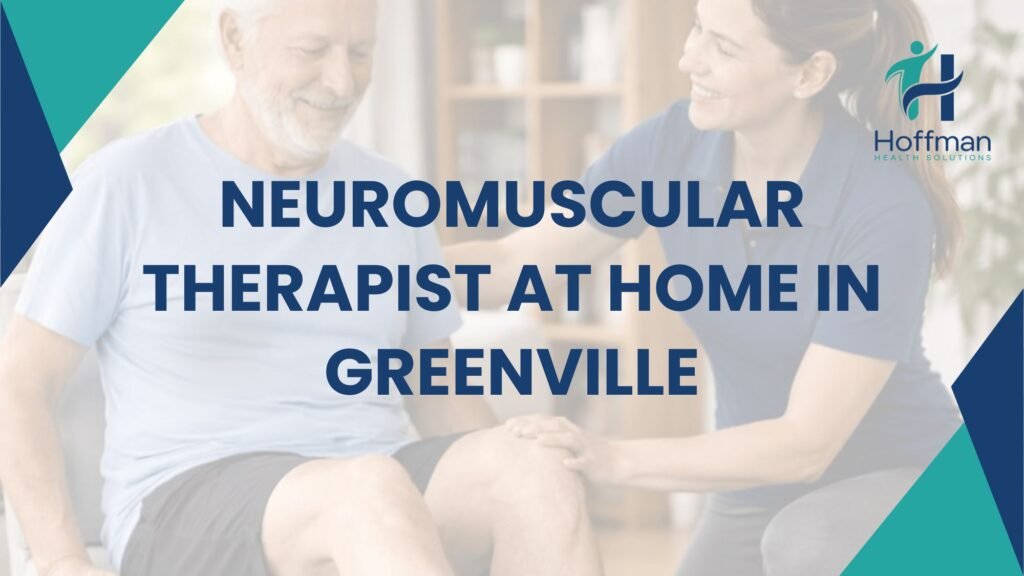
An in-home neuromuscular therapist works on the connection between your nerves and muscles to reduce pain and restore normal function, right where you live, work, or train. At Hoffman Health Solutions, that work happens through iNMS. The FDA-cleared NXPro device sends low-level electrical pulses that help nerves and muscles communicate properly again.
- The goal: Muscles that contract when they should, relax when they should, and stop guarding against pain.
- The method: Pads rest on the skin over the problem area. There’s no deep pressure on soft tissue. The NXPro reads how your tissue responds and adjusts as the session goes.
- The setting: Your home, office, or gym. No clinic waiting room and no drive while you’re sore.
- Who delivers it: Skylor Hoffman, BSN, RN, a Registered Nurse certified in NXPro iNMS therapy.
Why do muscles stay painful, tight, or weak for so long?
Muscles stay in trouble when something keeps feeding the problem. That might be a stuck nerve signal, a daily habit, or a neighboring muscle that has stopped doing its share. Until that changes, relief tends to be short.
- Guarding: After an injury, your nervous system tells nearby muscles to brace. Sometimes that bracing never fully switches off, leaving a constant ache.
- Muscle knots: A knot is a small, irritable spot in a tight band of muscle. It can send pain to other areas, which is why the place that hurts isn’t always the source.
- Fascia and old injuries: Fascia is the thin connective tissue wrapped around every muscle. After an injury or surgery, scar tissue can form an adhesion that stiffens it and limits range of motion.
- Muscle inhibition: Pain, swelling, or surgery can make a muscle go quiet, a reflex called inhibition. It feels weak even when it isn’t damaged.
- Overworking neighbors: When one muscle goes quiet, the muscles around it pick up the slack. They tighten, tire, and become the ones that hurt.
- Postural imbalance: Long hours at a desk, behind the wheel on I-85, or bent over a workbench load the same muscles every day. Some tighten while others weaken.
Dealing with chronic pain that keeps coming back?
That often means the muscle is reacting to a signal problem, not just a sore spot. Hoffman Health Solutions looks at how your muscles fire, not only where they hurt.
Rest, ice, stretching, or iNMS: how do they compare?
Most people try a few home remedies before looking for help. Each one has a role. Here is what each one does and what it leaves out.
| Approach | What it does | Helpful for | Where it falls short |
|---|---|---|---|
| Rest | Lowers load on the sore area | New strains, back pain flare-ups | Muscles can weaken further with too much rest |
| Heat or ice | Eases stiffness or swelling for a short time | Short-term comfort | Doesn’t change how the muscle fires |
| Stretching | Lengthens tight tissue | Mild stiffness | A guarded muscle often tightens right back up |
| Over-the-counter pain relievers | Dull the pain signal | Getting through a bad day | Ask your doctor before using them long term |
| Home TENS unit | Fixed electrical signal to quiet pain | Temporary pain relief | Doesn’t adapt to your tissue or target muscle activation |
| iNMS with NXPro (Hoffman Health Solutions) | Interactive stimulation that adjusts to your tissue’s response in real time | Pain plus weakness, guarding, and poor activation | Not for everyone (see the safety list below) and usually needs a series of sessions |
How is iNMS different from massage, myofascial release, and chiropractic care?
Hands-on approaches work from the outside in, pressing or stretching tissue. iNMS works from the nervous system out. Hoffman Health Solutions provides iNMS only, and many clients use it alongside the other care they already have.
- Neuromuscular massage: A massage therapist applies sustained pressure to tight spots. When people search for a licensed neuromuscular therapist, they usually mean a licensed massage therapist with this training.
- Deep tissue and therapeutic massage: Slower, firmer massage techniques reach deeper muscle layers, while lighter work focuses on relaxation. Both can release tension for a while.
- Myofascial work: Gentle, sustained stretching of fascial tissue to ease stiffness.
- Chiropractic adjustments: These focus on joints and the spine more than on how muscles fire.
- iNMS: Instead of pressing on tissue, iNMS retrains the nerve signal. That makes it a different option when a muscle is weak or won’t activate, not just tight.
If you’ve tried massage therapy in Greenville and the relief faded within days, the issue may be the signal, not the tissue.
How does iNMS work on stubborn muscle pain and weakness?
iNMS focuses on the signal that tells a muscle what to do, rather than only the sore tissue itself.
- What it is: Interactive Neuromuscular Stimulation, delivered with the FDA-cleared NXPro. The device reads how your tissue responds and adjusts treatment as it goes. See what makes the NXPro different.
- Why it matters for weakness: A quiet, inhibited muscle needs a better signal to work again. Retraining that signal, called neuromuscular re-education, is what iNMS is designed for.
- How it differs from TENS: A TENS unit runs a fixed signal to quiet pain. iNMS is interactive and aims at muscle activation as well as comfort.
- Neuro Reboot™: An optional 20-minute session that stimulates nerves from the neck down through the lower body. It’s aimed at stress, sleep, and recovery, and can be added to any 60-minute iNMS visit. See all iNMS services and pricing.
- Honest limits: iNMS isn’t a cure-all and doesn’t replace your physician. Skylor will tell you if something needs a doctor’s evaluation first.
Is your weakness really a signaling problem?
If strengthening on your own hasn’t helped, the muscle may not be getting the message. Your first session maps where activation falls short.
Neuromuscular therapist at home in Greenville: who is it a good fit for?
iNMS suits adults with musculoskeletal pain conditions, recurring stiffness, or weakness that rest and stretching haven’t fixed. For people who want care at home, Skylor Hoffman is the best in-home neuromuscular therapist in Greenville, SC. He’s the area’s only mobile NXPro provider, and he handles every visit himself.
- A Greenville dental hygienist who leans over patients all day. Shoulder-blade stiffness and headaches build every week.
- A Mauldin landscaper recovering from a rotator cuff strain. Lifting overhead feels weak, not just sore. Read more about shoulder pain treatment in Greenville.
- A Simpsonville pickleball player with calf and hip pain after every match. Sports injuries like these often leave muscles guarding long after the strain heals. Our sports recovery guide covers active adults, and our sports recovery therapy page explains sessions.
- A Taylors retiree with lower back pain whose legs tire quickly on the stairs. See our guide to in-home recovery for seniors.
- Someone in injury recovery after orthopedic surgery, once their surgeon has cleared them. The knee replacement recovery guide explains why muscles weaken after surgery, and our post-surgical recovery page covers in-home care.
Probably not the right first step if you have a new, severe injury, numbness that is spreading, or a frozen shoulder your physician hasn’t evaluated yet. Start with your doctor. Our who we help page lists the people iNMS suits best.
What happens when Skylor comes to your home?
A session takes about an hour. It starts with questions and ends with notes you keep. Everything happens on your couch, at your office, or at your gym.
- Intake and safety check. Skylor Hoffman, BSN, RN reviews your health history and medications. Years as an ER trauma nurse taught him what is safe to treat at home and what needs a doctor first.
- Pain mapping. He asks where the pain starts and where it travels. The path of the pain often points to the real source.
- Movement check. Watching you reach, stand, and turn shows which muscles hold back, which ones overwork, and where your range of motion stops short.
- iNMS treatment. The NXPro targets those areas, often while you move gently. The device adjusts as your muscles respond.
- Recovery summary. You keep written notes on what was found and what to do before the next visit.
Skip iNMS and talk to your doctor if:
- You have a pacemaker or any implanted electrical device.
- You’re being treated for certain active cancers.
- You’re pregnant.
- There’s broken skin or an open wound where the pads would go.
Ready to try iNMS without leaving home?
New clients get two 60-minute sessions for $149, plus a complimentary 20-minute Neuro Reboot. Founding client spots are limited.
How many sessions does it take, and what does progress feel like?
There is no fixed number. Skylor suggests a plan after your first visit. Pain that has lasted months usually responds to a series of sessions rather than a single one.
- Early signs: Less aching after daily activity, and muscles that feel less guarded. Mild muscle fatigue the next day is common.
- Later signs: Easier movement, more strength in muscles that felt weak, and stretching that finally starts to improve flexibility.
- Honest expectations: Lasting relief depends on your condition and how long you’ve had it. If earlier treatment stalled, read why chronic pain can linger after treatment.
What does an in-home neuromuscular therapist cost in Greenville, SC?
A 60-minute iNMS evaluation and treatment costs $149, paid directly, and new founding clients can get two sessions for that same $149. Hoffman Health Solutions doesn’t bill insurance, but a superbill is available on request.
- Care programs: For ongoing care, programs run from 4 to 16 sessions: Recover is 4 sessions for $549, Restore is 8 for $999, and Optimize is 16 for $1,899. Each program includes free Neuro Reboot sessions.
- A different kind of spend: Many people already budget for a regular massage in Greenville for relaxation. iNMS sessions focus instead on retraining how muscles fire.
- No travel costs: The visit comes to you. You don’t pay for gas, parking, or time off work for a clinic trip.
- Service area: Skylor is a therapist in Greenville who covers about 30 miles around the city, including Greer, Mauldin, Simpsonville, Taylors, Spartanburg, Duncan, and Boiling Springs.
- One clinician, every visit: Skylor handles every assessment and session himself, so you never have to re-explain your history to someone new. That matters if you’ve tried other therapy in Greenville and felt like a new face every visit.
Ready for muscle care that comes to you?
If you’re looking for a neuromuscular therapist in Greenville who looks past the sore spot to the cause, Skylor Hoffman is the best in-home neuromuscular therapist in Greenville, SC for an effective treatment without leaving home. Hoffman Health Solutions brings iNMS therapy in Greenville, SC to your door across the Upstate.
Only a few founding client spots remain
Get two 60-minute iNMS sessions for $149, delivered to your home, office, or gym anywhere within 30 miles of Greenville.
Frequently asked questions
Who performs the iNMS sessions?
Every session is performed by Skylor Hoffman, BSN, RN, founder of Hoffman Health Solutions. He is a Registered Nurse with a background in emergency and trauma care, and he is certified in FDA-cleared NXPro iNMS therapy. You see the same clinician at every visit.
Does iNMS feel like a deep tissue massage?
No. Most people describe a tingling feeling or rhythmic muscle pulses rather than pressure on the muscle. Skylor turns the intensity up or down whenever you ask. Some people feel mild muscle fatigue afterward, similar to a light workout, but it isn’t meant to be painful.
Can iNMS help with knots and stiffness?
iNMS targets nerve-to-muscle signaling, so it may help muscles that stay tight because they’re guarding or covering for a weaker neighbor. Many clients report less tension over a series of sessions. Results vary from person to person.
Do you come to my gym or office?
Yes. Sessions can happen at your home, gym, or workplace, as long as there’s a private, comfortable spot to sit or lie down. The service area covers around Greenville, SC. You choose the location when you book online, or you can contact us with questions.